

Eyelid cancer: 7 signs not worth ignoring
The skin of the eyelid is the thinnest in the body and gets sun every day. The tumours that appear there usually start out looking like trivial things, and that is precisely the difficulty.
By Dr. Miguel Ángel Olivardía Moreno · · Updated 3 de agosto de 2026
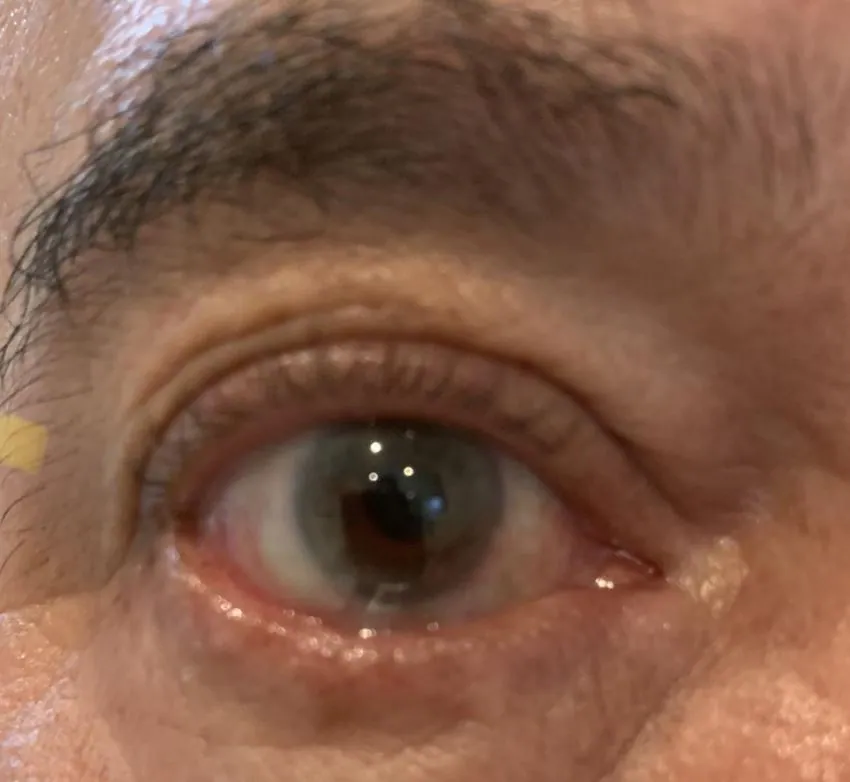
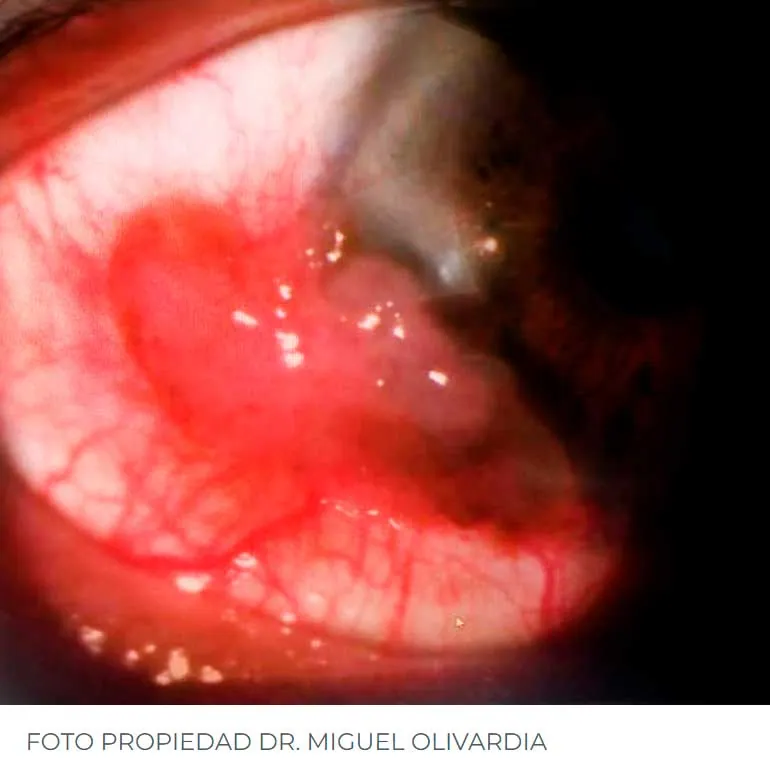
Malignant eyelid tumours are, for the most part, skin cancers. The most frequent is basal cell carcinoma, followed by squamous cell carcinoma and, less common but more aggressive, sebaceous carcinoma.
They share an uncomfortable trait: at first they do not look like anything serious. A small crust, a little lump, a stye that lingers. And because they do not hurt, patients wait.
Why the eyelid
Two reasons combine.
Eyelid skin is the thinnest in the body, with very little thickness between the surface and the deeper structures. And it receives cumulative sun exposure across a whole lifetime, in a country with high ultraviolet radiation twelve months of the year.
In Panama that exposure does not require going to the beach: it happens on the way to work, during outdoor activities, in everyday life. It accumulates slowly and over decades.
The seven signs
1. A lesion that never quite heals
A wound, crust or ulcer on the eyelid that has gone more than three or four weeks without closing completely. That it bleeds easily when dried or when washing your face is an added clue.
2. Loss of eyelashes at one particular spot
Localised absence of lashes in one segment of the eyelid margin — with none growing back — is one of the most specific signs of tumour infiltration of the margin. It is subtle and easy to overlook.
3. A stye that always comes back to the same place
Styes and chalazia are common and can recur. What should raise suspicion is that they reappear in exactly the same spot, over and over, or that a chalazion does not respond to the usual treatment. Sebaceous carcinoma mimics a chalazion with remarkable fidelity.
4. A lump that grows
Any lesion that steadily increases in size over weeks or months. Progressive growth counts for far more than appearance.
5. A change in the eyelid margin
A notch, an irregularity, an area that has lost its normal contour, or an eyelid that starts turning inwards or outwards for no apparent reason.
6. A mole that changes
On the eyelid the same criteria apply as on the rest of the skin: changes in size, colour, borders or symmetry of a pigmented lesion.
7. A hardened or retracted area
An area that feels firmer to the touch, or that pulls on the surrounding skin, may correspond to an infiltrating lesion growing beneath a deceptively normal-looking surface.
Only a biopsy gives the diagnosis
None of these signs, on its own, confirms a tumour. And none rules one out. Clinical examination points the way, photographic documentation allows comparison over time, but the definitive diagnosis comes from histopathology.
That is why, faced with a suspicious lesion, the correct course is to biopsy and not to observe through one more cycle.
Excision and reconstruction are one plan
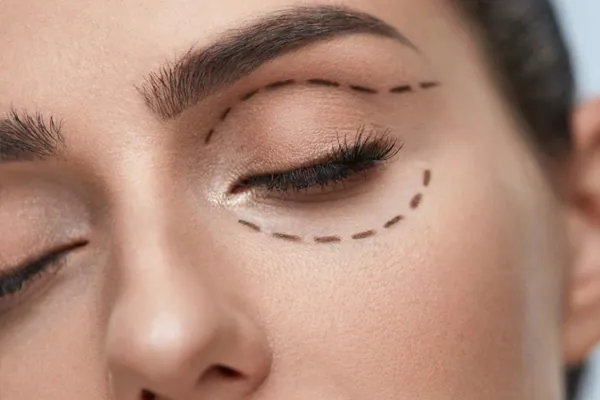
The eyelid is not just skin: it is an apparatus that closes, distributes the tear film and protects the cornea. Removing a tumour with no reconstructive plan can cure the cancer and create a serious functional problem.
That is why the approach is integrated: first a tumour-free margin is secured, then the defect is reconstructed with the patient's own tissue, aiming to preserve the closing function and an acceptable cosmetic result. The scale of it depends on the size of the lesion, which reinforces the argument for seeking help early: a small defect has simple solutions.
Reasonable prevention
- Sunglasses with certified UV protection and a generous frame.
- A wide-brimmed hat during the hours of strongest irradiation.
- Sunscreen around the eyes, in formulations suitable for that area.
- Periodic self-examination of the eyelid margin in front of a mirror.
- Assessment of any lesion that grows, bleeds or fails to heal.
In short
Most eyelid lesions are benign. But the ones that are not usually start out looking benign, do not hurt, and grow slowly. The only way for the diagnosis to arrive early is for the lesion to be assessed while it still looks like nothing much.