


Thyroid eye disease: when the thyroid pushes the eyes forward
Eyes that look more prominent, retracted eyelids and a changed appearance. What Graves' orbitopathy is, why treatment depends on the phase, and which signs mean urgency.
By Dr. Miguel Ángel Olivardía Moreno · · Updated 3 de agosto de 2026
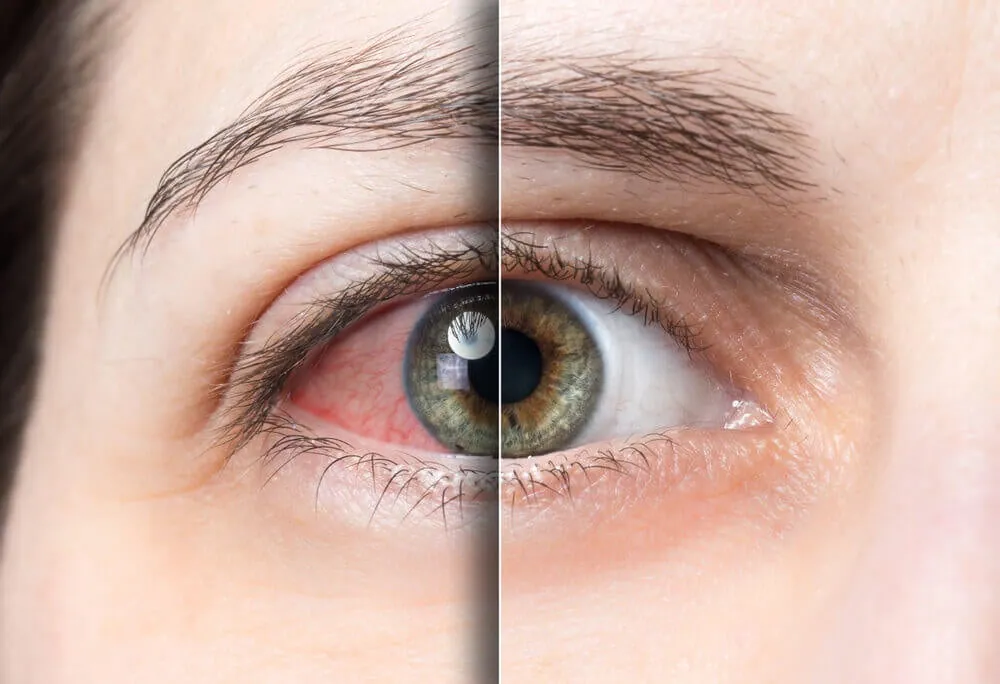
Thyroid eye disease — also called Graves' orbitopathy or thyroid-associated ophthalmopathy — is the ocular manifestation of autoimmune thyroid disease. It is the most frequent cause of eye protrusion in adults.
What happens is that the same autoimmune process that affects the thyroid gland also affects the tissues of the orbit: the orbital fat and the muscles that move the eye become inflamed and increase in volume. Because the orbit is a bony cavity of fixed size, that extra volume has only one way out: pushing the eyeball forward.
How it shows up
- Eye protrusion (proptosis): one or both eyes look more prominent.
- Eyelid retraction: the upper lid rises and exposes sclera above the iris, producing that characteristic staring expression.
- Incomplete closure of the eyelids, with consequent exposure and drying of the cornea.
- A gritty sensation, burning and watering.
- Double vision, when the thickened muscles restrict eye movement.
- Redness and swelling of the eyelids and conjunctiva.
- A feeling of pressure behind the eye.
It does not always coincide with the thyroid
This is probably the point that generates most confusion in clinic. The orbitopathy can appear before the thyroid problem is diagnosed, at the same time, or years after the thyroid is perfectly controlled. It can even occur in patients with normal thyroid function.
So controlling the hormone is necessary — and a priority — but it is not the treatment for the orbit. These are two fronts managed in parallel, ideally in coordination between endocrinologist and ophthalmologist.
The two phases
Understanding this explains why treatment is not the same at every moment.
Active phase. The inflammatory process is under way. Symptoms fluctuate, the protrusion may increase, there is pain and redness. It can last from months to a couple of years. The aim here is to control the inflammation and protect the cornea, not to reconstruct.
Inactive phase. The inflammation settles and the picture stabilises, leaving the anatomical sequelae: residual protrusion, eyelid retraction, restricted movement. This is the moment for reconstructive surgery.
Operating during the active phase produces unpredictable results, because you would be correcting something that is going to go on changing. That is why patience is part of the treatment, even if it is the hardest part to accept.
What is done in each phase
During the active phase:
- Strict control of thyroid function with the endocrinologist.
- Stop smoking. It is the modifiable factor with the greatest demonstrated impact on the severity of the disease.
- Intensive lubrication of the ocular surface, and protection at night if eyelid closure is incomplete.
- Targeted anti-inflammatory treatment, in cases that require it, under supervision.
- Monitoring of the optic nerve.
In the inactive phase, surgery usually follows a logical order, because each step changes the next:
- Orbital decompression, when the eye needs to be returned to its position by enlarging the available space.
- Muscle surgery, to correct double vision.
- Eyelid surgery, to correct retraction and improve closure.
Changing that order usually means having to repeat steps.
The warning signs
There is one complication that changes the urgency of the whole picture: compressive optic neuropathy. When the thickened muscles compress the optic nerve at the orbital apex, vision can be lost progressively and, if nothing is done, permanently.
Seek help immediately in the event of:
- A drop in vision.
- A change in colour perception, which usually precedes loss of acuity.
- Severe orbital pain.
- An eye that cannot close, with pain and blurred vision — a possible exposure corneal ulcer.
None of those situations should wait for the next available appointment.
A disease that also weighs on the outside
It is worth saying: thyroid eye disease changes the appearance of the face, sometimes markedly, and it does so in an area that is central to how others recognise us. The impact on the patient's social and working life is real and should not be treated as secondary.
That reconstructive surgery has to wait for the inactive phase does not mean that aspect is ignored. It means it is planned for the moment when the result will be stable.