



Pterygium: the growth on the eye and Panama's sun
We live squarely in the band of highest incidence in the world. What that growth actually is, when it needs surgery, why it comes back and what distinguishes it from something more serious.
By Dr. Miguel Ángel Olivardía Moreno · · Updated 3 de agosto de 2026

A pterygium is a growth of fibrovascular conjunctival tissue that advances onto the cornea, usually from the inner corner of the eye. It is commonly called «a growth» or «surfer's eye».
It is not a tumour. It is the tissue's response to chronic insult, mainly from ultraviolet radiation.
Why it is so common here
There is a geographical band described as the «pterygium belt», corresponding roughly to the latitudes near the equator, where the incidence of this condition is markedly higher. Panama lies within that band.
The factors that combine:
- High ultraviolet radiation all year round, with no seasonal variation to give any respite.
- Prolonged work or activity outdoors.
- Exposure to wind, dust and dry environments, which irritate the ocular surface.
- Reflection of radiation off water and pale surfaces.
In clinic it is especially frequent in people whose work takes place in the open air: construction, transport, fishing, agriculture, maritime activities.
How it shows up
- A fleshy-looking, triangular tissue advancing from the inner corner towards the cornea.
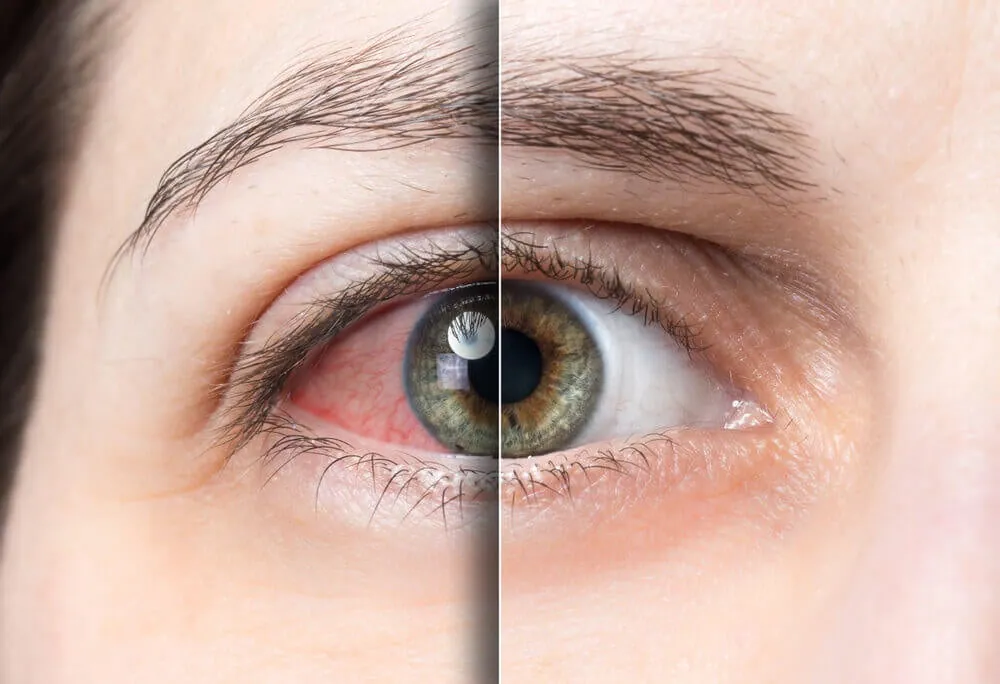
- Redness of the area, which worsens with sun, wind or dust.
- A foreign-body sensation and burning.
- Induced astigmatism: by pulling on the cornea, it distorts it and alters vision.
- In advanced cases, invasion of the visual axis and restriction of eye movement.
When it is operated on
Not every pterygium needs surgery. A small, stable, minimally symptomatic pterygium can be monitored with sun protection and lubrication.
Surgery is indicated when:
- It advances and approaches or reaches the visual axis.
- It induces astigmatism that compromises vision.
- Irritation persists despite medical treatment.
- It restricts eye movement.
- There is diagnostic doubt requiring histopathological study.
- The cosmetic reason matters to the patient and the case allows it.
The problem of recurrence
This is the central conversation before operating on a pterygium. The main complication is not a surgical complication in the classic sense: it is that the tissue grows back.
And there is an important nuance: a recurrent pterygium is usually more aggressive and harder to treat than the original, with more inflammation and a greater tendency to fibrosis.
That is why the technique matters. Simple excision leaving the sclera bare — the quickest and simplest procedure — has fairly high recurrence rates. Techniques that cover the defect with a graft of the patient's own conjunctiva reduce that risk considerably.
It is worth the patient asking which technique is going to be used. It is not an irrelevant technical detail: it is the factor with the greatest influence on whether they will need surgery again.
After surgery
- Rigorous, sustained sun protection. The same cause that produced the pterygium is still there.
- Lubrication of the ocular surface.
- The prescribed anti-inflammatory treatment, adherence to which directly influences the risk of recurrence.
- Scheduled check-ups, especially during the first months, which is when recurrence usually shows itself.
What a pterygium is not
Two useful distinctions:
Pinguecula. A yellowish thickening of the conjunctiva, next to the limbus, that does not invade the cornea. It rarely requires surgery, although it can become inflamed. Over time, some progress to a pterygium.
Ocular surface squamous neoplasia. This one is a potentially malignant lesion, and it can resemble an atypical pterygium. It should be suspected in the face of rapid growth, a gelatinous or intensely vascularised appearance, an unusual location, or in immunosuppressed patients.
The practical consequence is simple: when an ocular surface lesion with atypical features is removed, the tissue is sent for histopathology. The diagnosis is not assumed.
Prevention
The only real prevention is reducing cumulative exposure:
- Sunglasses with certified UV protection, preferably wraparound, so that they also block lateral radiation.
- A wide-brimmed hat during the middle hours of the day.
- Lubrication in dry, windy or dusty environments.
- Specific eye protection for outdoor work.
It matters especially in childhood and youth: much of the ultraviolet damage that shows up in adulthood accumulated decades earlier.