

Dry eye in Panama: why air conditioning makes it worse
We live in a humid country and spend the day in dry environments. That contradiction explains a good share of the consultations for burning, grittiness and vision that clouds over at work.
By Dr. Miguel Ángel Olivardía Moreno · · Updated 3 de agosto de 2026

Panama has one of the highest ambient humidities in the region. And yet dry eye is one of the most frequent reasons for consultation. The explanation lies not in the climate outdoors but in that of the spaces where we spend the day.
The environment we actually live in
Between the office, the car, the shopping centre and the house, much of the day passes under air conditioning. Air conditioning cools by dehumidifying: it takes water out of the air. That speeds up evaporation of the tear film, a layer only microns thick and extremely sensitive to the conditions around it.
If the unit's airflow is also pointed directly at the face — a situation as common as it is unnoticed — the effect multiplies.
On top of that comes the second factor: screens. When we concentrate on a screen, the blink rate falls significantly. And blinking is what redistributes the tear film over the cornea and what empties the glands of the eyelid margin that supply the oily layer preventing evaporation.
Less blinking, in a drier environment, for eight hours a day.
Why a dry eye can water
This is the consultation that most confuses patients: «doctor, I can't have dry eye, my eyes water all the time».
The tear film has three components: an aqueous one, a mucous one and an oily one. If the oily layer fails — the most common situation, and closely tied to blepharitis — the tear evaporates too quickly even if the volume is normal. The surface becomes irritated, and that irritation triggers a reflex tear: watery, abundant and of poor quality, which runs down but does not lubricate.
The patient's eyes water and are dry at the same time. Both things are true.
The symptoms
- Burning or stinging, especially at the end of the day.
- A gritty or foreign-body sensation.
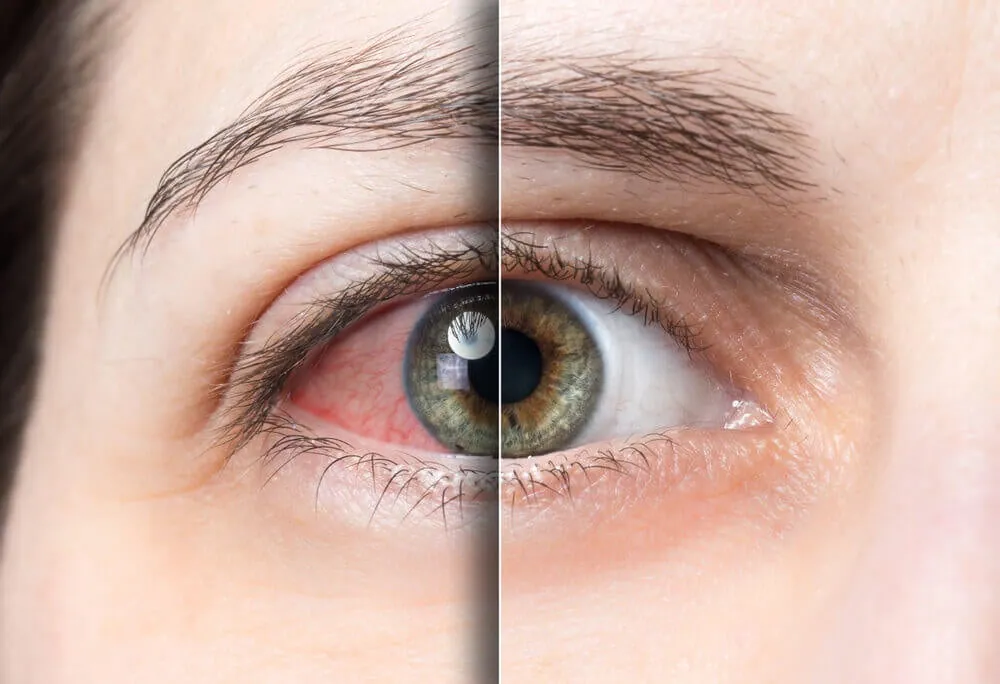
- Persistent redness.
- Vision that clouds over and clears on blinking.
- Visual fatigue when reading or working with screens.
- Discomfort with contact lenses that were previously well tolerated.
- Paradoxically, watering.
That symptom of fluctuating vision is very characteristic and very useful diagnostically: measured visual acuity is normal, but the patient's quality of vision is not, because the surface on which the image forms is irregular.
What is assessed at the consultation
Not all dry eyes are the same, and treatment depends on the mechanism:
- Examination of the eyelid margin and the meibomian glands, looking for associated blepharitis.
- Assessment of the stability of the tear film.
- Surface staining to detect epithelial damage on the cornea and conjunctiva.
- Review of the patient's medication: antihistamines, antidepressants, contraceptives, isotretinoin and several others all contribute.
- Ruling out associated systemic disease, such as the autoimmune syndromes that affect the glands.
- A history of previous eye surgery: refractive and cataract surgery reduce corneal sensitivity and with it the blink reflex.
Treatment
Environmental measures. Redirect the air conditioning flow so that it does not point at your face. Take regular visual breaks during screen work. Lower the monitor below eye level, so that the eyelid covers more of the ocular surface. Blink consciously and completely.
Lubrication. Artificial tears, preferably preservative-free if they are going to be used more than three or four times a day, because with frequent use the preservative itself irritates.
Eyelid hygiene. When there is blepharitis or dysfunction of the eyelid glands — and there is in a large proportion of cases — warm compresses and cleaning of the eyelid margin are the treatment of the cause, not an extra.
Medical treatment. In moderate or severe cases, prescription medication aimed at inflammation of the ocular surface is needed. Here management must be supervised.
Treating what lies behind it. If rosacea, an autoimmune disease or a medication is involved, dry eye will not settle stably without addressing that.
When to stop self-medicating
Seek help if symptoms persist for more than a few weeks despite lubricating, if there is frank pain, if vision is affected in a sustained way, or if significant light sensitivity appears. Simple dry eye is a nuisance; severe dry eye can damage the cornea, and that is a scenario best not reached.